
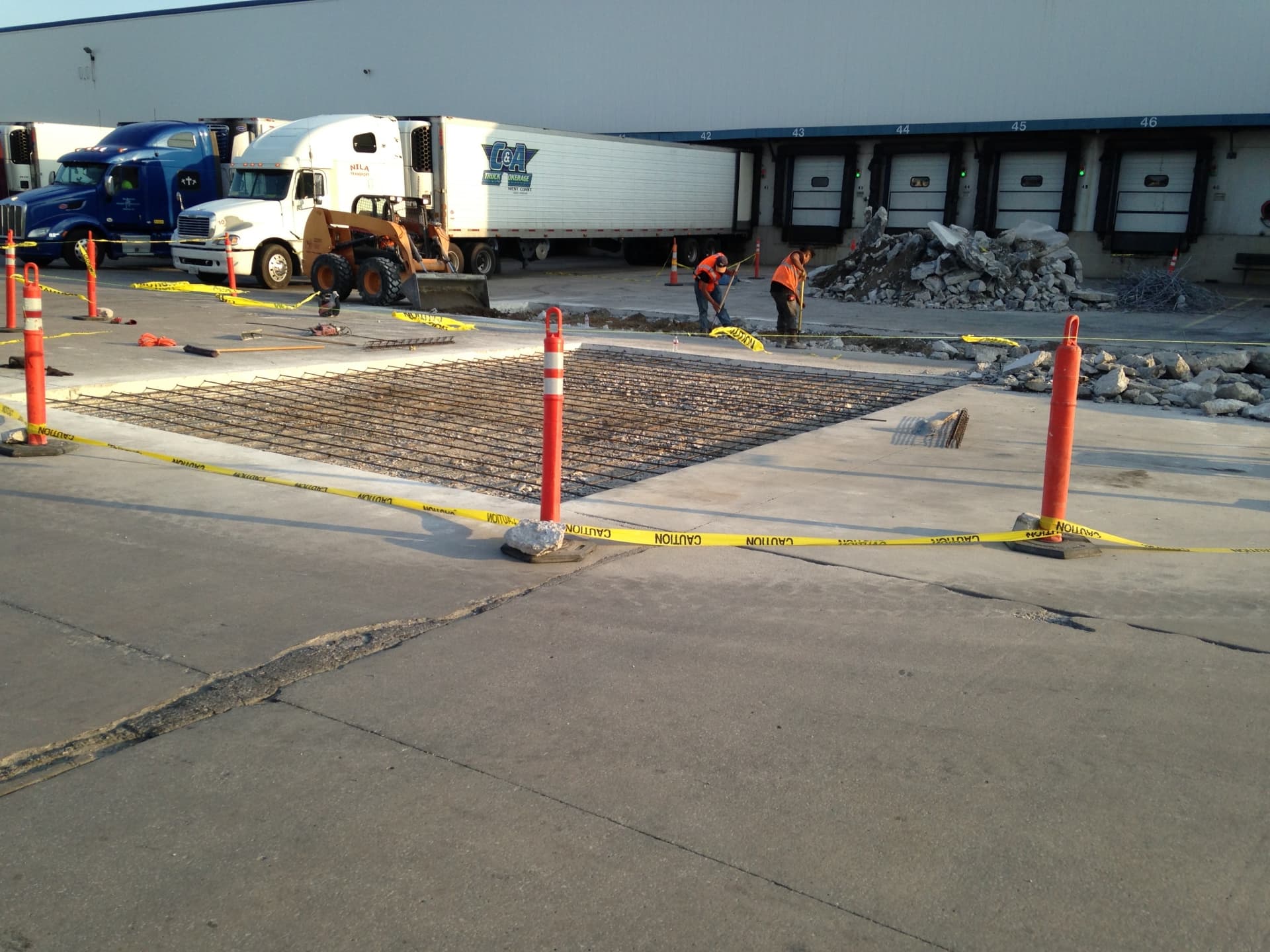
Dumpster Pads and Loading Areas: Why Standard Slabs Fail Under Heavy Trucks
Walk any commercial property that has been open for a decade and the worst concrete on the site is almost always in the same two places: the trash enclosure and wherever delivery trucks stop. The parking stalls can be immaculate while the dumpster pad is broken into pieces. That is not bad luck. Those areas take a completely different kind of load, and a slab designed for cars will not survive them.
The Load Is Not What You Think
A loaded front-load refuse truck is heavy, but weight alone is not what destroys the pad. The damage comes from how that weight gets applied. When the truck lifts a full container overhead, the load transfers forward onto the front axle in a short, violent cycle, concentrating enormous force through two contact patches at almost the same spot every single week.
Roll-off trucks add drag. The container is winched on and off across the slab, scraping steel across the surface under load. Delivery trucks and semi-trailers bring their own version of the problem: trailer landing gear parks a fully loaded trailer on two small steel pads, which is one of the highest point loads a commercial slab will ever see.
The common thread is concentration and repetition. Ordinary parking spreads moderate loads across a whole lot. These operations put extreme loads on the same few square feet, thousands of times.
Why Asphalt Almost Never Works Here
Asphalt is a flexible pavement and it deforms under sustained point loads, particularly when it is warm. A dumpster sitting on asphalt in August will press its feet into the surface. Add the truck's front axle landing in the same place each week and the result is rutting, then cracking, then a pothole that grows every collection day.
Asphalt also has a chemistry problem in this specific location. Petroleum-based liquids dissolve asphalt binder, and dumpster leachate, hydraulic fluid, and cooking grease all end up on a trash pad. This is why so many municipalities require concrete at refuse enclosures even on otherwise asphalt sites, and it is a large part of why concrete tends to win the surface comparison for commercial lots in general.
What a Properly Built Pad Looks Like
Specifications vary by jurisdiction and by hauler, so this is a description of the pattern rather than a spec to build from. Pads built for this duty are thicker than standard paving, commonly in the range of eight inches, poured at a higher strength mix, and reinforced with bar rather than mesh because of the point loading involved. The reinforcement question is worth understanding on its own terms, which we cover in our comparison of rebar and wire mesh.
Underneath it, the base has to be compacted properly. A thick slab on soft subgrade still fails, it just takes slightly longer and costs more when it does.
The Apron Is the Part Everyone Forgets
The single most common design mistake is building a pad exactly the size of the enclosure. The container sits on the pad, the truck stops on standard pavement, and the truck's front axle lands squarely on the weakest surface on the site at the moment of highest load.
A pad needs an apron extending well out in front of the enclosure, sized so the truck's front wheels are on heavy-duty concrete during the lift. Where that apron meets standard paving matters too, because a joint placed under the wheel path is a joint that will fail. Small layout decisions like joint location relative to traffic are the sort of thing that separates a pad that lasts twenty years from one that needs attention in five, and they are exactly the details covered in our guide for property managers running concrete projects.
Access, Approach, and Slope
The pad has to be reachable in a straight approach. If a truck has to turn tightly onto the pad, the tires scrub sideways across the surface and grind the finish off. Enclosure gates that open into the approach path, bollards placed too close, and pads tucked into corners all force maneuvering that damages both the concrete and the enclosure.
Slope needs a light touch. Enough fall to move water and washdown away from the enclosure, but not enough for a container to roll or for the truck to work at an angle. Standing water at a trash pad is a nuisance complaint waiting to happen, and it accelerates deterioration in freeze-thaw weather.
Where the pad sits relative to accessible routes and parking is also worth checking early, since a poorly placed enclosure can push circulation into conflict with the slope limits described in our overview of ADA requirements for commercial concrete.
What Failure Costs
A broken dumpster pad is not a cosmetic problem. Haulers can refuse service to an enclosure they cannot safely access, which turns a concrete issue into an operations issue very quickly. Broken concrete around the enclosure becomes a trip hazard in an area employees use daily, and standing water and exposed subgrade at a trash pad are the kind of thing that draws attention during a health or fire inspection.
Replacing a failed pad also costs more than building the right one, because it means demolition, disposal, base repair, and a service interruption. The cost gap between an adequate pad and an undersized one at construction is usually modest. Once you are into commercial concrete repair on a failed pad, the math has moved considerably.
Frequently Asked Questions
How large should a dumpster pad be?
Large enough for the containers, the enclosure walls, and an apron that puts the truck's front wheels on the pad during the lift. The container count and the hauler's truck configuration determine the numbers, so ask the hauler before designing the pad.
Can a damaged pad be repaired instead of replaced?
If the damage is limited to surface spalling or a single panel and the base is intact, a partial repair can work. If the slab is broken across multiple panels or the subgrade has failed, patching tends to buy a season or two at best.
Do loading dock aprons need the same treatment?
Yes, and often more. Trailer landing gear and repeated dock maneuvering produce point loads and scrubbing comparable to refuse service, which is why dock aprons are typically specified as heavy-duty concrete.
Is a concrete pad required by code?
Many jurisdictions require concrete at refuse enclosures, and some specify minimum thickness and pad dimensions. Check local code before design, since it may set the floor for your specification.
Build It Once With K&E Flatwork
Trash pads and loading areas are the highest-abuse concrete on a commercial site and they deserve to be designed as such. We build loading docks, retaining walls, and ramps along with heavy-duty commercial concrete throughout the Kansas City area, and we would rather talk about the truck before we talk about the pour.
Contact K&E Flatwork for a free estimate, or call 816-837-5260.
.jpg)
Ready to Get Your Project Moving?
Commercial concrete services built for performance, reliability, and long-term value. Speak directly with our team to get started.


designed and developed by Treasure Advertising 💚