
Rebar vs. Wire Mesh: How Concrete Reinforcement Actually Works
Ask two contractors what goes inside a slab and you can get two different answers, both defensible. Rebar and welded wire mesh are not competing products doing the same job badly and well. They solve different problems, and the right choice depends on what the slab has to carry, how thick it is, and what the ground underneath it is doing. Understanding the difference is also the fastest way to tell whether a bid is thin.
Why Concrete Needs Help at All
Concrete is extremely strong in compression and weak in tension. A typical flatwork mix might handle several thousand pounds per square inch of squeezing and only a small fraction of that in pulling. Every slab experiences tension somewhere: at the bottom when it spans a soft spot, at the top when a heavy wheel sits over a void, and throughout as it shrinks during curing.
Steel is the opposite. It is excellent in tension and it expands and contracts at almost the same rate as concrete, which is the quiet reason the two work together at all. Reinforcement does not stop concrete from cracking. It holds the pieces together and keeps the crack tight enough that the slab keeps behaving like a slab.
What Welded Wire Mesh Actually Does
Welded wire mesh, sometimes called welded wire fabric or by its old name of remesh, is a grid of relatively light steel wires. Its purpose is crack width control. When shrinkage cracking occurs, the mesh keeps the two sides of the crack from separating and from shifting vertically, so the slab stays level and the crack stays hairline rather than opening up into a trip hazard.
Mesh is common in thinner residential flatwork, patios, sidewalks, and light-duty slabs. It does very little for structural capacity. If a slab needs to carry concentrated loads or span weak subgrade, mesh is not the answer.
What Rebar Adds
Rebar is heavier deformed steel bar, most often half-inch bar in flatwork, tied into a grid at regular spacing. Unlike mesh, rebar meaningfully increases the slab's ability to carry load and to bridge soft areas underneath. It is the normal choice for slabs at five or six inches and thicker, for anything that will see trucks, and for slabs on subgrade that cannot be fully trusted.
Rebar also changes what a failure looks like. A mesh slab that fails tends to crack and settle. A properly reinforced slab that gets overloaded tends to crack while staying together and staying level, which is the difference between a repair and a replacement.
Placement Matters More Than the Material
This is the part that decides whether reinforcement was worth paying for. Steel only does its job if it sits in the part of the slab that goes into tension, which for most flatwork means the upper middle third rather than the bottom. Reinforcement lying on the ground when the concrete is placed is, structurally, almost decorative.
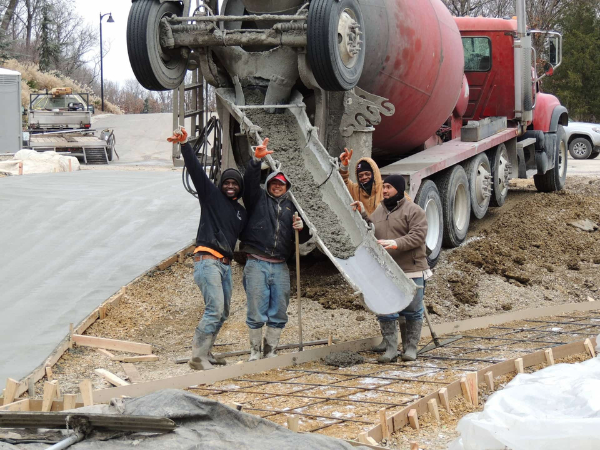
Proper placement means chairs or supports holding the steel at the specified height, and it means the crew not walking it back down into the mud during the pour. The old practice of laying mesh flat and hooking it up with a rake as the concrete goes in is unreliable at best. If you are watching a pour and the steel is not visibly supported, that is a fair question to ask, and it belongs on the list of things covered in our look at the hidden costs of poor concrete work.
Reinforcement Cannot Fix Bad Ground
Steel is not a substitute for a properly prepared base. A slab sitting on soft, uncompacted, or poorly draining subgrade will move, and reinforcement only determines how gracefully it fails. Expansive clay soils, which are common through much of the Kansas City metro, move seasonally with moisture content and will work on a slab for years.
Getting the ground right first is the cheaper half of the problem, which is why soil stabilization comes up so often on commercial sites. A well reinforced slab on bad subgrade is money spent in the wrong order.
Reinforcement and Jointing Work Together
Reinforcement and joint layout are two halves of the same crack strategy. Joints decide where cracking happens; steel decides what the crack does once it is there. Heavily reinforced slabs can sometimes carry wider joint spacing because the steel holds cracks tight, while lightly reinforced slabs need joints closer together. Our explanation of how control joints work covers the spacing side of that equation.
How It Shows Up in a Bid
Reinforcement is one of the easiest line items to quietly downgrade, and it is invisible the moment the concrete is placed. If one bid is noticeably cheaper than the others, the difference is often thickness, mix strength, base preparation, or steel, and steel is the one nobody can inspect afterward.
A clear proposal should state the slab thickness, the mix strength, the reinforcement type and spacing, and how the steel will be supported. Comparing those four lines across bids is more useful than comparing totals, and it puts the cost differences described in our breakdown of what different slabs actually run into context.
Frequently Asked Questions
Does a residential driveway need rebar or is mesh enough?
It depends on thickness, soil, and what will park on it. Mesh can be adequate for a thin slab on good ground carrying passenger cars. Rebar is the safer specification for thicker slabs, poor subgrade, or anywhere a truck or RV will sit.
Can fiber reinforcement replace steel?
Fibers mixed into the concrete help control very early shrinkage cracking and can reduce surface cracking, but they do not provide the load-carrying or crack-holding capacity of properly placed steel. They are usually a supplement, not a substitute.
Can reinforcement be added to an existing slab?
Not in any practical sense. Reinforcement is placed before the pour. An existing slab that is failing for lack of steel is a replacement conversation, not a retrofit.
Will rebar rust and damage the concrete?
Steel with adequate concrete cover around it is protected by the alkaline environment of the concrete. Rusting becomes a problem when cover is too thin or when chlorides reach the steel through cracks, which is another reason placement and crack control matter.
Get a Straight Answer on What Your Slab Needs
Reinforcement should be specified for the job in front of it, not chosen by habit. If you are planning commercial concrete work and want to understand what is actually going into the slab and why, we are happy to walk through it before anything gets ordered.
Contact K&E Flatwork for a free estimate, or call 816-837-5260.
.jpg)
Ready to Get Your Project Moving?
Commercial concrete services built for performance, reliability, and long-term value. Speak directly with our team to get started.


designed and developed by Treasure Advertising 💚